

India-South Korea mega deal: India and South Korea have taken a major step toward strengthening ties as Prime Minister Narendra Modi and President Lee Jae Myung announced plans to deepen cooperation.
In a landmark diplomatic move that signals a new era of “futuristic partnership,” Prime Minister Narendra Modi and South Korean President Lee Jae-myung have committed to nearly doubling bilateral trade between the two nations to $50 billion by 2030.

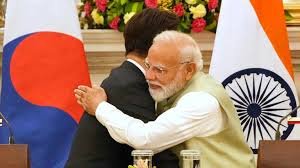
The state visit of President Lee (April 19–21, 2026), the first by a South Korean leader in eight years, has resulted in a flurry of agreements spanning semiconductors, shipbuilding, and green energy. The summit at Hyderabad House on Monday underscored a shared vision: moving beyond a traditional buyer-seller dynamic toward a deeply integrated strategic alliance. India-South Korea mega deal
The $50 Billion Roadmap: Upgrading the Trade Engine
The centerpiece of the summit was the decision to fast-track the upgrade of the Comprehensive Economic Partnership Agreement (CEPA). While the original 2010 pact opened doors, India has long expressed concerns over a growing trade deficit.
To address this, the two leaders launched the India-ROK Industrial Cooperation Committee. This ministerial-level body will focus on making trade “fairer and more balanced.” India-South Korea mega deal
Joint Strategic Vision for India-ROK Partnership
| Key Economic Milestone | Detail |
| Current Trade | Approx. $27 billion (₹2.25 lakh crore) |
| 2030 Target | $50 billion (₹4.15 lakh crore) |
| CEPA Status | Negotiations to be finalized by 2027 |
| New Mechanisms | Industrial Cooperation Committee & Financial Forum |
Strategic Pillars: Shipbuilding and Semiconductors
The “Mega Deal” is built on several high-tech pillars designed to leverage South Korea’s industrial prowess and India’s massive market and manufacturing potential. India-South Korea mega deal
1. Rebuilding the Seas: The Shipbuilding Framework
South Korea is a global titan in shipbuilding, and India wants in. The two nations adopted a Comprehensive Framework for Partnership in Shipbuilding, Shipping, and Maritime Logistics.
-
Modernization: Korean firms will help upgrade Indian shipyards.
-
Expansion: Plans include building a new dry dock in India to construct large, specialized vessels.
-
Collaboration: Focus on “next-generation” autonomous maritime cranes and green shipping.
The Digital Bridge: Semiconductors and AI
With the launch of the India-Korea Digital Bridge, the focus shifts to the “brains” of modern technology..
-
Chips: President Lee expressed serious interest in India’s semiconductor incentives. Both leaders invited Korean tech giants to set up fabrication units (fabs) in India. India-South Korea mega deal
-
AI for All: Aligning India’s “MANAV” AI initiative with Korea’s tech ecosystem to nurture talent and research.
The Steel Strength: POSCO’s Grand Return
In a significant industrial win, JSW Steel and South Korea’s POSCO announced a 50:50 joint venture to build a 6 million tonne integrated steel plant in Odisha. This marks a triumphant return for POSCO to the state, following previous project delays, and secures a critical link in the global steel supply chain. India-South Korea mega deal
A “Special Strategic” Bond in a Turbulent World
Beyond the balance sheets, the visit carried heavy geopolitical weight. Both leaders addressed the “turbulent and fast-changing world,” specifically referencing tensions in the Indo-Pacific and West Asia. India-South Korea mega deal
-
Security: Both nations strongly condemned cross-border terrorism and “violent extremism in all its forms.”
-
Indo-Pacific: South Korea formally joined the Indo-Pacific Oceans Initiative (IPOI), aligning its “Pragmatic Diplomacy” with India’s “Act East” policy. India-South Korea mega deal
-
Green Future: India joined the Global Green Growth Institute (headquartered in Seoul), while South Korea reinforced its commitment to the India-led International Solar Alliance (ISA).
Connecting People: The “K-Wave” Meets the “I-Pulse”
The partnership isn’t just about factories; it’s about people. To foster a deeper cultural connection, the leaders announced:
-
Year of Friendship: 2028-2029 will be celebrated as the Year of India-ROK Friendship.
-
Cultural Exchange: The current exchange program has been extended until 2030.
-
Sister Cities: New energy was breathed into existing ties like Busan-Mumbai, Incheon-Kolkata, and Ulsan-Chennai.
What This Means for the Indian Audience
For the average Indian, this “Mega Deal” translates to jobs and technology.
-
Manufacturing Jobs: The establishment of a dedicated Korean Industrial Township for Small and Medium Enterprises (SMEs) will likely create thousands of skilled manufacturing roles.
-
Tech Transfer: As Korean companies shift supply chains from other regions to India, the “Make in India” initiative gets a high-tech boost. India-South Korea mega deal
-
Digital Ease: The proposed interlinking of digital payment systems could eventually make transactions between the two nations as seamless as a domestic UPI transfer.
As President Lee Jae-myung concludes his visit, the message is clear: the relationship between the “Tiger of the East” and the “Elephant of the South” is no longer just about selling cars and phones—it’s about co-creating the technology of the future.
-
Joint Strategic Vision for India-ROK Partnership The official statement from the Press Information Bureau (PIB) detailing the roadmap for the Special Strategic Partnership from 2026 to 2030, including the launch of the Industrial Cooperation Committee. India-South Korea mega deal
-
Details on the $50 Billion Trade Target A comprehensive breakdown of the trade milestones and the new “Digital Bridge” initiative for AI and semiconductor collaboration.
-
JSW & POSCO’s Mega Steel Plant in Odisha A detailed report on the $1.09 billion investment in Odisha, highlighting the specific districts (Dhenkanal and Keonjhar) and the environmental focus of the new facilities.