

Trump Praises Modi In a development that has sent ripples through international diplomatic circles, former US President Donald Trump has highly praised Indian Prime Minister Narendra Modi, dropping strong hints of a robust US backing for India in the event of any major regional crisis. The statements, coming at a time of complex global realignments, underscore the deeply intertwined geopolitical interests of Washington and New Delhi.

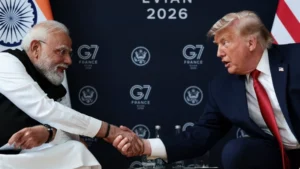
This public display of diplomatic solidarity is not merely an exchange of political pleasantries. It represents a calculated signal to regional adversaries and a testament to the evolving nature of the Indo-US strategic partnership. For political analysts, policymakers, and global observers, this open commitment changes the calculus of security and deterrence across the Indo-Pacific theater.
The Chemistry of Leadership: Analyzing the Trump-Modi Bond
The personal rapport between Donald Trump and Narendra Modi has long been a defining feature of modern bilateral ties. From the historic ‘Howdy, Modi!‘ rally in Houston to the massive ‘Namaste Trump’ event in Ahmedabad, their public interactions have consistently projected unmatched mutual respect. Trump Praises Modi
A Public Declaration of Friendship
In his latest address, Trump did not hold back in acknowledging Modi’s leadership style, describing him as a “strong, capable, and visionary leader” who has successfully elevated India’s status on the world stage. Trump pointed out that under Modi’s governance, India has transitioned from being a passive regional actor into an assertive global power.
Diplomatic experts note that Trump’s leadership philosophy heavily favors leaders who project strong domestic authority. By praising Modi, Trump is reinforcing his long-standing belief that stable, nationalist leadership is crucial for maintaining global order and balance.
Trump signals possible US support in conflict
Reading Between the Lines: The “Crisis” Signal
What caught the immediate attention of defense experts was Trump’s explicit reference to potential security challenges facing India. By signaling that the United States would stand firmly with India during a security or economic crisis, Trump has effectively raised the stakes for any nation attempting to challenge India’s territorial sovereignty or economic interests.
This statement serves as an unwritten security guarantee, suggesting that under a strategic framework aligned with his philosophy, Washington would not remain neutral if New Delhi faced external aggression. Trump Praises Modi
Geopolitical Implications: Redefining Balance in the Indo-Pacific
The Indo-Pacific region has fast become the primary geopolitical battleground of the 21st century. Trump’s signals of unconditional backing for India add a layer of tactical deterrence to an already tense environment.
The Message to Regional Adversaries
India shares prolonged, sensitive borders marked by historical friction and recent standoffs. A clear, high-level signal of American backing alters the strategic calculus of India’s neighbors in several distinct ways:
-
Deterrence on the Border: It introduces a variable of American military, intelligence, and logistical support, making localized border misadventures incredibly costly for adversaries. Trump Praises Modi
-
Intelligence Sharing Consolidation: Stronger backing implies that the US will continue to provide real-time, high-altitude satellite imagery and telemetry data to Indian defense forces, neutralizing unexpected troop movements.
-
Naval Cooperation in the Indian Ocean: It reinforces the joint commitment to keeping critical maritime choke points free from unilateral dominance, ensuring uninterrupted global trade.
The Evolving Role of the Quad Alliance
While the Quadrilateral Security Dialogue (Quad)—comprising the US, India, Japan, and Australia—operates on a multilateral level, Trump’s statements highlight the crucial importance of the bilateral spine within that alliance.
Economic and Trade Alignment: Beyond Military Alliances
A true strategic partnership cannot survive on defense agreements alone; it requires a deep, institutionalized economic foundation. Trump’s praise for Modi also touched upon the immense potential of bilateral trade.
The Shift in Global Supply Chains
The global corporate landscape is actively seeking to diversify its supply chains away from high-risk, authoritarian manufacturing hubs. Trump’s endorsement of India as a reliable security partner simultaneously positions the country as a premium destination for American capital investment. Trump Praises Modi
| Strategic Sector | US Technology Contribution | India’s Scaling Capability |
| Semiconductor Manufacturing | Advanced R&D and Design Architecture | Large-scale skilled workforce and infrastructural layouts |
| Defense Co-production | Jet Engine Technology transfer (e.g., GE F414) | Domestic manufacturing via ‘Make in India’ initiatives |
| Artificial Intelligence & Cyber | Enterprise software systems and cloud infrastructure | Massive data processing systems and software engineering pools |
Navigating Historical Trade Friction
It is no secret that during his presidency, Trump took a hardline stance on trade tariffs, occasionally calling out India’s import duties on items like Harley-Davidson motorcycles and medical devices. However, his latest statements suggest an understanding that overarching security alignments outweigh localized trade disputes.
The consensus building up is that a economically robust India is inherently beneficial to American security objectives in Asia.
Domestic Political Dimensions: The NRI Factor and Voting Blocs
The public camaraderie between the two leaders also carries significant domestic political weight within the United States, particularly concerning the highly influential Indian-American diaspora.
The Power of the Indian Diaspora
The Non-Resident Indian (NRI) community in the US is one of the most affluent, highly educated, and politically active demographic groups. Historically leaning towards moderate policies, the diaspora has increasingly shown a deep interest in how Washington handles its relationship with New Delhi. Trump Praises Modi
By aligning himself closely with Modi—who enjoys widespread popularity among large segments of the diaspora—Trump is making a direct, strategic play for the political and financial backing of Indian-American community leaders, business owners, and voters in crucial swing states.
Bi-Partisan Consensus on India
Trump’s statements also highlight an important reality in Washington: while American politics is deeply polarized on almost every domestic issue, there is a rare, rock-solid bi-partisan consensus regarding India.
Whether an administration is led by Democrats or Republicans, the institutional view remains unchanged—India is an indispensable strategic anchor for the United States in the 21st century.
Defense Co-production: The New Frontier of Cooperation
The era of India simply buying off-the-shelf military hardware from western nations is rapidly coming to an end. The future of Indo-US ties lies in joint research, development, and co-production.
Breaking Monopolies on Critical Tech
Historically, India relied heavily on legacy defense architectures from Eastern Europe. Trump’s signaling of full support accelerates India’s diversification strategy. Trump Praises Modi
The US has progressively granted India access to highly guarded defense technologies, a privilege usually reserved only for close NATO allies. This includes advancements in unmanned aerial vehicles (UAVs), counter-drone systems, and elite marine surveillance gear.
Enhancing Technological Interoperability
With increased joint military exercises across the army, navy, and air force, the integration of American technology into the Indian defense matrix ensures that in a moment of extreme crisis, both forces can seamlessly communicate, share data links, and execute coordinated humanitarian or defensive operations.
Conclusion: A New Era of Global Realignment
Donald Trump’s high praise for Prime Minister Narendra Modi and his clear signals of US backing mark a significant chapter in contemporary geopolitics. It reflects a mutual understanding that the security challenges of the future cannot be solved in isolation. A strong, secure, and resilient India is vital for American interests, just as dependable US strategic backing provides India with the geopolitical leverage necessary to navigate a volatile neighborhood.
As this partnership continues to mature, the world will be watching closely to see how this powerful leadership dynamic translates into concrete policies that shape the future of global peace and stability.
Frequently Asked Questions (FAQs)
Q1: What did Donald Trump say about PM Narendra Modi recently? Donald Trump praised PM Modi’s leadership, calling him a strong and visionary leader, while signaling that the US would provide robust backing to India during any major regional security or economic crisis. Trump Praises Modi
Q2: How does this development impact the Indo-Pacific security dynamic? The clear signal of US backing strengthens tactical deterrence in the region, reassuring India’s defense establishment while altering the strategic calculations of regional adversaries along India’s borders.
Q3: Is the US-India partnership supported by both political parties in America? Yes. While political divisions are high in the US, maintaining a strong, strategic, and economic relationship with India is one of the few areas that enjoys unanimous bi-partisan support in Washington. Trump Praises Modi