

PM Modi’s Big Sweden Pitch During his high-profile visit to Gothenburg, Sweden, Prime Minister Narendra Modi delivered a powerful, forward-looking economic vision to European industry leaders. Addressing a room full of Swedish CEOs and members of the European Round Table for Industry, PM Modi introduced a sharp evolution of India’s flagship economic policy. The new mantra?

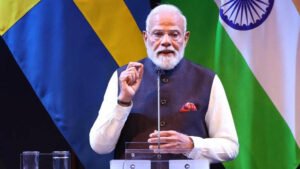
India, Make in India, and Export from India.”
This is a significant strategic leap. For the past decade, the “Make in India” initiative focused primarily on import substitution—encouraging global brands to manufacture inside India to serve the massive domestic consumer market. However, this fresh pitch in Sweden signals that India is ready for the next level: transforming the country into a premier global export launchpad.
The timing of this pitch could not be more critical. With global corporations desperately looking for a “China+1” strategy to diversify their supply chains, India is positioning itself as the ultimate alternative. By combining Sweden’s world-renowned reputation for high-tech innovation and sustainability with India’s massive workforce, tech talent, and unprecedented market scale, this bilateral partnership is setting the stage for a new manufacturing era. PM Modi’s Big Sweden Pitch
The Strategic Shift: Decoding “Make in India, Export from India”
When the “Make in India” initiative was first launched, the goal was simple: reduce India’s heavy reliance on foreign imports by building localized manufacturing capacity. While that phase was highly successful—evident in India’s spectacular rise as a global mobile phone manufacturing hub—the 2026 economic landscape demands a more aggressive approach. PM Modi’s Big Sweden Pitch
The upgraded blueprint, “Design for India, Make in India, Export from India,” represents a complete end-to-end manufacturing ecosystem.
Research and Development (R&D) and deep-tech ownership. PM Modi explicitly invited Swedish firms to set up their global R&D centers in India, leveraging the country’s massive pool of young engineers, data scientists, and software developers.
Why Sweden? The Synergy of Innovation and Scale
Sweden might be a small nation by population, but it is an absolute titan when it comes to global innovation, engineering prowess, and sustainable green technology. From automotive giants like Volvo and aerospace leaders like Saab to telecommunication pioneers like Ericsson, Swedish industry has a historic footprint in India. PM Modi’s Big Sweden Pitch
The Power of Co-Creation
During delegation-level talks with Swedish Prime Minister Ulf Kristersson and European Commission President Ursula von der Leyen, PM Modi emphasized that the relationship between New Delhi and Stockholm has evolved far beyond a traditional “buyer-seller” dynamic. It is now a Strategic Partnership rooted in co-creation and joint industrial development.
Sweden leads the world in green transition technologies, circular economy models, and smart urban mobility. India, on the other hand, offers a booming economy, next-generation digital public infrastructure (UPI, ONDC), a fast-growing middle class, and an insatiable energy demand. When Swedish green engineering is paired with Indian industrial scale, the resulting products can provide affordable, sustainable climate solutions not just for India, but for the entire world. PM Modi’s Big Sweden Pitch
The Big Pillars: Where Sweden and India are Collaborating
The bilateral discussions in Gothenburg focused on high-tech, future-proof industrial sectors. If you are tracking where the big investment money is moving, these are the primary sectors driving the new India-Sweden strategic roadmap.
1. The Clean Energy and Green Hydrogen Frontier
India has set an incredibly ambitious goal to achieve net-zero emissions, driving massive investments into the National Green Hydrogen Mission. Sweden is a global pioneer in fossil-free industrial processes—such as producing green steel using hydrogen instead of coal. PM Modi’s Big Sweden Pitch
PM Modi made a compelling case for Swedish clean-tech firms to integrate heavily into India’s green transition, setting up production facilities for green hydrogen electrolyzers, advanced solar grids, and large-scale wind energy infrastructure.
2. Deep Tech, AI, and the Tech Corridor
With the formal announcement of the Sweden-India Technology and AI Corridor, both nations are creating a direct pipeline for collaborative research in Artificial Intelligence, machine learning, and deep-tech hardware manufacturing.
This corridor will facilitate talent mobility, allowing Indian software experts and Swedish automation engineers to build cutting-edge industrial AI applications. Additionally, semiconductor manufacturing and next-gen telecom (6G development) are key areas where Swedish telecom giants are looking to expand their Indian manufacturing lines. PM Modi’s Big Sweden Pitch
3. Semiconductor and Electronics Manufacturing
The global electronics supply chain remains highly vulnerable to geopolitical shocks. India is aggressively building out its semiconductor ecosystem with multibillion-dollar incentive packages (PLI schemes). PM Modi highlighted India’s readiness to support European semiconductor design and packaging units, offering them a highly stable, transparent, and democratic manufacturing environment.
Case Study: SAAB’s Landmark Defense Facility in Haryana
The absolute best real-world proof of PM Modi’s “Make in India, Export from India” vision is already playing out in the defense sector. Swedish aerospace and defense giant Saab has made history by becoming the first foreign defense company to receive 100% Foreign Direct Investment (FDI) approval to manufacture on Indian soil.
The Carl-Gustaf M4 Weapon System Plant
Saab has officially broken ground on a brand-new, state-of-the-art manufacturing facility in Jhajjar, Haryana. This factory will produce the iconic Carl-Gustaf M4 shoulder-launched weapon system. PM Modi’s Big Sweden Pitch
This project perfectly embodies the shift in India’s economic strategy:
-
The History: The Indian Army has been buying and importing Carl-Gustaf systems from Sweden since the 1970s (Buyer-Seller model).
-
The Transition: Under the new Strategic Partnership, the weapons will be fully manufactured inside India (Make in India).
-
The Future Export Hub: The Haryana plant is not just for the Indian Armed Forces. It will manufacture specialized components and complete weapon systems to satisfy Saab’s global export orders to other friendly nations (Export from India).
This defense facility serves as a powerful blueprint for other highly sensitive industries like aerospace, semiconductors, and commercial automotive sectors.
Driving the “Reform Express”: Why India is Attractiveness to European Investors
A crucial element of PM Modi’s pitch to the European Round Table for Industry was reassuring global investors that India’s domestic economic environment is highly stable, predictable, and business-friendly. He noted that over the last 12 years, the country has operated on a strict mantra of “Reform, Perform, and Transform.” PM Modi’s Big Sweden Pitch
To back up this claim, several macroeconomic structural shifts were highlighted to the Swedish CEOs.
Next-Generation Infrastructure and Logistics
Historically, the biggest complaint from foreign investors looking at India was bottlenecked logistics and poor infrastructure. The Indian government has aggressively tackled this through the PM Gati Shakti National Master Plan, a digital platform that synchronizes multi-modal connectivity projects across railways, roadways, and shipping ports.
With dedicated freight corridors and massive modern port developments, the time and cost of moving manufactured goods from an Indian factory floor to an international cargo ship have drastically dropped.
The India-EU Free Trade Agreement (FTA)
A massive catalyst for this renewed economic energy is the historic conclusion of the India-European Union Free Trade Agreement (FTA). Dubbed by European leaders as the “mother of all deals,” this comprehensive trade pact eliminates restrictive tariffs, simplifies customs procedures, and provides unprecedented market access for both Indian exporters and European investors.
The FTA provides a highly secure legal and financial framework, giving Swedish companies the long-term confidence required to invest billions of dollars into Indian manufacturing plants. PM Modi’s Big Sweden Pitch
The Broad Economic Impact: What This Means for Everyday Indians
While international diplomatic visits and high-level CEO roundtables can feel distant to the average citizen, the economic ripple effects of the “Export from India” shift directly impact the domestic economy.
1. High-Skill Job Creation
Mass manufacturing for export markets requires rigorous quality control and technical expertise. The expansion of Swedish companies into India will create thousands of high-paying, high-skill jobs in engineering, precision manufacturing, industrial automation, and corporate R&D. This helps solve a critical domestic challenge: providing meaningful employment to India’s highly educated, young professional workforce.
2. Boosting the MSME Ecosystem
Global giants like Volvo or Saab do not operate in isolation. When they set up a massive manufacturing plant, they rely on a vast network of local tier-1 and tier-2 suppliers for components, raw materials, logistics, and maintenance. This creates an incredible growth opportunity for Indian Micro, Small, and Medium Enterprises (MSMEs), forcing them to upgrade their quality standards to match international benchmarks. PM Modi’s Big Sweden Pitch
3. Balancing the Trade Deficit and Strengthening the Rupee
When India successfully transitions from an import-dependent nation to a global export powerhouse, the country earns massive amounts of foreign currency reserves. A consistently strong export trajectory directly helps narrow the national trade deficit, stabilizing the Indian Rupee against global currencies like the US Dollar and insulating the domestic economy from international inflation shocks.
Conclusion: A Visionary Leap for Global Manufacturing
Prime Minister Narendra Modi’s economic pitch in Sweden marks a definitive turning point in India’s industrial narrative. By evolving the core philosophy to “Design for India, Make in India, and Export from India,” the country is signaling its readiness to move up the global value chain.
The partnership with Sweden—anchored by historical trust, democratic transparency, and cutting-edge innovation—offers a perfect blueprint for how a developing economic superpower and a highly advanced technological nation can co-create future solutions. As projects like Saab’s defense facility in Haryana lead the charge, the message to global boardrooms is clear: India is no longer just a massive market to sell to; it is the premier destination to manufacture for the world. PM Modi’s Big Sweden Pitch