

The Middle East has been pushed to the brink of an all-out regional war. Following a direct directive from US President Donald Trump, the United States military has launched a massive, multi-wave aerial assault on the Islamic Republic of Iran. The strikes have triggered powerful explosions across several Iranian cities, including the capital, Tehran, and major strategic hubs along the Persian Gulf.

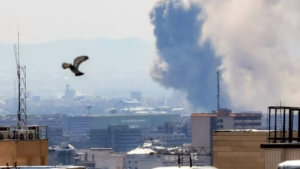
In immediate retaliation, Iran’s Islamic Revolutionary Guard Corps (IRGC) launched drone and missile barrages targeting major US military bases in the Gulf, specifically hitting installations in Bahrain and Kuwait. Furthermore, Tehran has officially declared the Strait of Hormuz—the world’s most critical oil chokepoint—closed to all maritime traffic, warning that any vessel attempting to pass will be targeted.
This dramatic escalation marks the total collapse of a fragile, two-month-old ceasefire and threatens to disrupt global energy supplies, send shockwaves through international markets, and ignite a prolonged, catastrophic conflict.
The Trigger: Why Is the US Bombing Iran Now?
The current flashpoint was ignited by a rapid sequence of events over a 48-hour period, shattering the uneasy truce that had been established in April. Iran war news LIVE:
The Hindu Live Updates on West Asia War
The Guardian Live Blog on Middle East Crisis
The Downing of a US Apache Helicopter
The immediate catalyst for the American military action was the downing of a US Army Apache attack helicopter over the strategic waters of the Strait of Hormuz. President Trump immediately and unequivocally blamed Tehran for the incident, branding it an act of “unwarranted and continued aggression.”
While Iran asserted that foreign forces near its territory remain at “constant risk” and accused the US of violating its sovereign airspace, Washington labeled the shoot-down a direct violation of international law and a provocation that required an immediate, heavy-handed military response. Iran war news LIVE:
“Negotiating with Bombs”: The Trump Administration’s Stance
Speaking from the White House, President Trump expressed deep frustration over what he described as stalled diplomatic progress, accusing Iranian leadership of dragging out discussions for a comprehensive peace deal.
“We were really close to a deal, but they keep tapping us along,” Trump told reporters in the Oval Office. “They keep playing us for suckers. Now they will have to pay the price. We hit them hard yesterday, and we’re going to hit them hard again today.”
Reinforcing this aggressive stance, US Defense Secretary Pete Hegseth delivered a stern warning to journalists at US Central Command (CENTCOM) headquarters in Tampa, Florida. Hegseth explicitly defended the consecutive nights of airstrikes, stating that the US military objectives were designed to force Iran into compliance. He remarked that the United States would “negotiate with bombs” if necessary, ensuring that the military operations would be “strong, clear, and devastating.”
Deep Inside the US Military Operation: Over 49 Tomahawks Launched
The scope of the American air campaign is one of the most significant military demonstrations of force in the region in recent years. Executed under the direct oversight of CENTCOM, the operation has utilized a combination of naval power and advanced air assets.
Tehran and the Western Suburbs
Residents in western Tehran reported hearing deep, rumbling explosions that shook residential buildings. While the core city center was not directly targeted, the strikes on nearby military command nodes caused widespread panic, leading to massive traffic congestion as citizens attempted to seek shelter. Iran war news LIVE:
Hindustan Times Gulf War Live Coverage
2. Bandar Abbas
As Iran’s primary naval outpost and a vital commercial shipping hub, Bandar Abbas was a central focus of the US Centcom operation. The city’s military port facilities and surrounding anti-aircraft batteries were subjected to heavy bombardment.
3. Qeshm Island and Sirik
Situated directly inside the narrowest corridor of the Strait of Hormuz, Qeshm Island holds immense strategic value. US naval aircraft targeted Iranian Revolutionary Guard maritime monitoring stations on the island to blind Tehran’s oversight of passing warships. Simultaneously, neighboring Sirik and Minab saw their military communication infrastructure completely neutralized.
Iran’s Retaliation: US Bases Under Fire in the Gulf
Tehran did not wait long to respond to the American onslaught. Mirroring the rhetoric of their leadership, the IRGC mobilized its extensive regional network of drones and ballistic missiles to launch immediate counter-attacks against US personnel and assets stationed across the Gulf.
Airstrikes on Bahrain and Kuwait
The IRGC officially claimed responsibility for launching waves of kamikaze drones and precision-guided ballistic missiles targeting several key American military installations: Iran war news LIVE:
-
Sheikh Isa Air Base (Bahrain): Home to crucial US aviation assets, the base activated its air defense sirens as incoming projectiles were detected.
-
Ali Al Salem Air Base (Kuwait): A critical logistics hub for US forces in the Middle East, this installation was targeted by multiple low-flying drones.
-
Ahmad Al-Jaber Air Base (Kuwait): This facility also faced incoming fire, forcing personnel into hardened underground bunkers.
While Western defense officials confirmed that air defense systems—including Patriot missile batteries—were highly active and intercepted the vast majority of the threats, the sheer volume of incoming fire has put thousands of American service members in the region under imminent risk. Iran war news LIVE:
The Threat to Regional Allies
Iran’s Foreign Ministry issued a sharp, uncompromising message to its neighbors in the Gulf, including Saudi Arabia, the UAE, and Jordan. Tehran warned that these nations hold a “legal and moral responsibility” to deny the US and Israel use of their airspace or domestic bases for launching strikes against Iran.
The Iranian government made it clear that any nation facilitating American military aggression would be viewed as an active participant in the war, raising fears of retaliatory strikes on civilian infrastructure and oil refineries across the entire Arabian Peninsula.
Global Energy Shock: Strait of Hormuz Closed
The most immediate and far-reaching economic consequence of this military escalation is the complete closure of the Strait of Hormuz.
Why the Strait of Hormuz Matters
The Strait of Hormuz is widely considered the most vital maritime transit corridor in the world. Approximately one-fifth of the world’s total petroleum consumption passes through this narrow waterway daily, making it the literal throat of the global energy market.
Iran’s Ironclad Blockade and Attacks on Tankers
Following the second night of US strikes, Iran’s top joint military command announced that the strait was closed until further notice.
“All traffic in this vital waterway, including oil tankers and commercial vessels, is barred. Any vessel attempting passage will be targeted and shot at,” the IRGC command statement read. Iran war news LIVE:
Proving that this was not an empty threat, Iranian media quickly reported that the IRGC Navy had successfully struck two “violating ships” that attempted to illegally transit the waterway without authorization. The identity of the tankers and the nationalities of their crews remain under investigation, prompting immediate diplomatic crises, including India summoning foreign envoys after reports emerged of a vessel carrying Indian sailors being caught in the crossfire near Oman.
What triggered the sudden US military strikes against Iran?
A: The immediate catalyst was the downing of a US Army Apache attack helicopter over the strategic waters of the Strait of Hormuz. President Donald Trump blamed Tehran directly, calling it an act of unwarranted aggression. This shattered a fragile two-month-old ceasefire that had been established in April. Iran war news LIVE:
Q2: What is the official stance of the Trump administration?
A: The administration has adopted a high-pressure “negotiate with bombs” strategy. President Trump accused Iranian leadership of playing the US for “suckers” and stalling comprehensive peace talks. Defense Secretary Pete Hegseth reinforced this, stating that heavy military operations are designed to force Iran into compliance.
What are the primary demands from both sides to achieve peace?
A: The stalemate exists because both nations have non-negotiable demands:
-
The United States demands: An immediate halt to Iran’s domestic nuclear enrichment program, a permanent end to ballistic missile development, and guaranteed safety for international shipping lanes.
-
Iran demands: An immediate end to US airstrikes, the complete removal of crippling economic sanctions, the unfreezing of billions of dollars in overseas assets, and the withdrawal of foreign military forces from the Persian Gulf. Iran war news LIVE: