
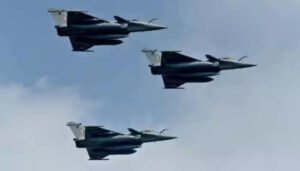
France bets on Rafale F5: France’s decision to push ahead with the next-generation Rafale F5 fighter aircraft has sparked fresh debate in India’s defence circles, especially as New Delhi moves closer to finalising its long-awaited Multi-Role Fighter Aircraft (MRFA) deal. The development is significant because the Indian Air Force (IAF) is already evaluating a massive 114-fighter acquisition programme, widely expected to centre around the Rafale platform.
## The “Super Rafale” F5: What’s the Big Deal?
To understand why this matters to India, we first have to look at what France is building. The F5 standard is designed to transform the Rafale from a 4.5-generation fighter into a “6th-generation-ready” platform. France bets on Rafale F5
The Birth of the ‘Super Rafale’: What is the F5?
The Rafale F5 is not just an upgrade; it is a reinvention. Often dubbed the “Super Rafale,” the F5 standard is designed to operate in the 2030s and beyond, bridging the gap between current 4.5-generation fighters and the future FCAS (Future Combat Air System).
Key Features of the F5:
-
The “Loyal Wingman”: The F5 will not fly alone. It is being developed alongside a stealth combat drone (derived from the nEUROn project) that the pilot can control to suppress enemy air defenses (SEAD) or scout dangerous territory.
-
Hypersonic Strike: It is designed to carry the ASN4G, a scramjet-powered hypersonic nuclear missile, ensuring France’s (and potentially its partners’) strategic deterrence remains untouchable. France bets on Rafale F5
-
Next-Gen Eyes: Featuring the Thales RBE2 XG radar (Gallium Nitride based) and an overhauled SPECTRA electronic warfare suite, it can “see” and “jam” better than almost anything in the sky. France bets on Rafale F5
-
AI Integration: The F5 uses advanced AI to help pilots process the massive amounts of data coming from its sensors, reducing pilot fatigue in high-intensity combat.
France to finance Rafale F5 development alone after UAE co-funding talks collapsed
Rafale F5 vs F4: Should India Wait Or Buy Fighter Jets Now?
Why the F5 Matters for India’s MRFA Deal
India’s MRFA program seeks 114 fighter jets to arrest the alarming dip in its squadron strength. Currently, the IAF operates around 29–31 squadrons against a sanctioned strength of 42. While the Rafale is the frontrunner, the F5 development has introduced three critical “Strategic Ripples” in the negotiations. France bets on Rafale F5
- F4 vs F5 Upgrades: Rafale F4 focuses on connectivity and networked warfare, while F5 emphasizes multi-system combat, collaborative operations with drones, and advanced electronic warfare and cyber protection.
Hypersonic Punch: The F5 is being built to carry the ASN4G—a hypersonic nuclear-capable missile—and the next generation of cruise missiles. France bets on Rafale F5
Why France is betting on Rafale F5
The Rafale F5 is being projected by France as the future of its combat aviation ecosystem. While the current F4 variant is already among the most advanced 4.5-generation fighters in service, the F5 is expected to push the platform closer to “sixth-generation” warfare capabilities. France bets on Rafale F5
The “Future-Proofing” Dilemma
In early 2026, the Indian Defence Acquisition Council cleared the path for the 114-jet deal. However, a major talking point is whether India should buy the current F4 standard (which is battle-ready now) or wait/negotiate for the F5 standard.
-
The Risk: Buying F4s now might mean the jets are a generation behind by 2035.
-
The Solution: Current negotiations suggest a “hybrid” approach—purchasing the F4 now with a guaranteed “evolutionary path” to F5, ensuring the 114 jets don’t become obsolete. France bets on Rafale F5
The Source Code Standoff
A professional yet tense “tug-of-war” is currently playing out between New Delhi and Paris. India is insisting on access to the Rafale’s source code.
-
India’s Logic: To truly “Make in India,” the IAF needs the ability to integrate its own weapons (like the Astra BVR missile or the BrahMos-NG) and its own electronic warfare suites without asking France for permission every time.
-
France’s Concern: Paris is protective of its “crown jewels.” There is also a quiet concern about India’s close defense ties with Russia; France fears that providing full software access could inadvertently expose sensitive Western tech to Russian-origin systems. France bets on Rafale F5
The Industrial “Second Home”
Dassault Aviation is reportedly planning a second assembly line in Hyderabad. With 96 of the 114 jets slated to be built in India, the F5 development means Indian engineers won’t just be “bolting parts together.” They will be learning the architecture of an aircraft that is being built to fight in the 2040s. France bets on Rafale F5
Comparison: The F5 vs. The Competition
In the MRFA race, the Rafale faces the American F-15EX and F-21, the Swedish Gripen-E, and the Eurofighter Typhoon. Here is how the F5 bet shifts the scales:
| Feature | Rafale F5 (France) | Competitors (USA/EU) |
| Stealth Support | Paired with Stealth Drone (nEUROn) | F-15EX is a “missile truck,” not stealthy. |
| Nuclear Capability | Primary platform for French deterrent | Subject to strict US/NATO export controls. |
| Sovereignty | 100% French (No US ITAR restrictions) | Often dependent on US components/approvals. |
| Adaptability | Designed for “Indo-French” integration | Integration of Indian weapons is often costly. |