
CM Vijay Rallies for Textile Industry Chief Minister Vijay has officially written a high-priority letter to Prime Minister Narendra Modi. The core agenda? A direct appeal for central intervention to completely scrap the controversial 11% import duty on raw cotton.
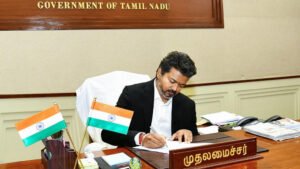
For an industry already battling volatile global demand, fluctuating domestic yields, and stiff competition from neighboring nations like Bangladesh and Vietnam, this 11% levy has fast become a breaking point. CM Vijay’s letter isn’t just a routine administrative request; it is a loud distress signal on behalf of thousands of spinning mills, handloom weavers, garment manufacturers, and exporters who are watching their margins evaporate into thin air. CM Vijay Rallies for Textile Industry
But why has a seemingly standard import duty sparked such a massive uproar? How does an international tax policy impact the price of a basic t-shirt or bedsheet produced locally? In this exhaustive, deep-dive analysis, we will break down the entire controversy, explore the arguments presented by CM Vijay, look at the ground reality of the textile industry, and analyze what a potential waiver could mean for the Indian economy.
The Core Crisis: Decoding the 11% Import Duty on Cotton
To fully understand why Chief Minister Vijay has taken this step, we need to take a step back and look at the anatomy of this tax structure. The 11% import duty on raw cotton is not a single tax; it is a combination of a basic customs duty and the Agriculture Infrastructure and Development Cess (AIDC).
Originally introduced to shield domestic cotton farmers from cheap international imports and to fund rural infrastructure, the policy had well-meaning roots. The idea was simple: make imported cotton expensive so that Indian textile mills would be forced to buy exclusively from Indian farmers. CM Vijay Rallies for Textile Industry
Textile Ministry Studying Demand for Removal of Import Duty on Cotton
Why Textile Mills Cannot Just “Buy Local”
The fundamental flaw in relying solely on domestic supply is a matter of quality and variety, not just quantity. India is one of the largest producers of cotton globally, but the domestic market primarily produces short to medium-staple cotton.
For high-end textile manufacturing—especially for premium apparel, luxury garments, and specialized medical or technical textiles—mills require Extra-Long Staple (ELS) cotton. This specific variety of long, silky fiber is not grown in sufficient quantities within India due to specific climatic limitations and seed availability.
Why Textile Mills Cannot Just “Buy Local”
The fundamental flaw in relying solely on domestic supply is a matter of quality and variety, not just quantity. India is one of the largest producers of cotton globally, but the domestic market primarily produces short to medium-staple cotton.
For high-end textile manufacturing—especially for premium apparel, luxury garments, and specialized medical or technical textiles—mills require Extra-Long Staple (ELS) cotton. This specific variety of long, silky fiber is not grown in sufficient quantities within India due to specific climatic limitations and seed availability. CM Vijay Rallies for Textile Industry
The Squeeze on Spinning Mills
Spinning mills transform raw cotton bales into yarn. They are the first to absorb the shock of the 11% duty. Over the last few quarters, dozens of spinning units across major textile hubs have been forced to cut down their operational shifts from seven days a week to just three or four days. Operating at 50% capacity means their fixed costs (like electricity, factory rent, and machinery loans) remain the same while their revenue plummets.
The Panic Among Powerloom and Handloom Weavers
When spinning mills struggle, yarn prices skyrocket or become highly unpredictable. Small-scale powerloom operators and traditional handloom weavers do not have the financial reserves to handle weekly price changes in yarn. When yarn becomes too expensive, these weavers simply stop their looms, leading to localized economic recessions in historical weaving towns.
Balancing the Scales: Why the Import Duty Was Introduced in the First Place
To maintain an objective, well-rounded view, we must look at the opposite side of the coin. The Central Government did not implement the 11% duty arbitrarily; there was a specific defensive logic involved, primarily centered around protecting the Indian farmer.
The Farmer Protection Argument
The Ministry of Agriculture and associated policymakers argue that without import tariffs, international traders could dump cheap, subsidized surplus cotton from foreign nations into the Indian market. If the domestic market is flooded with low-cost international cotton, the prices in Indian mandis would crash below the government-mandated Minimum Support Price (MSP).
If local prices crash, millions of Indian cotton farmers—particularly in regions like Vidarbha, Telangana, and parts of Gujarat—would face severe financial ruin, exacerbating the rural agrarian crisis. CM Vijay Rallies for Textile Industry
The Revenue Generation for Rural Infrastructure
The AIDC (Agriculture Infrastructure and Development Cess) component of the import duty is earmarked for developing rural infrastructure, improving cold storage chains, and modernizing local agricultural markets. The government’s perspective is that the funds collected from importing industries are directly funneled back into fortifying the nation’s agricultural foundations.
Finding a Middle Ground: Potential Policy Solutions for PM Modi
With CM Vijay forcefully championing the cause of the manufacturing industry and the central policy looking out for agricultural interests, the Prime Minister’s Office (PMO) faces a delicate balancing act. A flat, uncompromising stance from either side will cause damage.
What are the realistic, pragmatic policy solutions that can resolve this deadlock?
1. Introducing a Seasonal Duty Waiver
One of the most practical solutions involves implementing a flexible, seasonal duty window. The government could completely waive the 11% import duty during the lean domestic cotton season (typically between May and September).
During these months, Indian farmers have already sold the bulk of their harvest to ginners and traders, so removing the import duty would not hurt the farmers’ direct earnings. It would, however, allow spinning mills to import foreign cotton at a fair price during months when local supply is naturally depleted. CM Vijay Rallies for Textile Industry
2. Specific Duty Exemption for Extra-Long Staple (ELS) Cotton
Since the primary issue stems from the shortage of premium long-staple cotton, the government could create a targeted tariff exemption. By removing the 11% duty only on ELS cotton varieties (which are clearly identifiable through customs and quality grading), the center can completely protect domestic farmers who grow short/medium staple cotton, while simultaneously giving high-end garment exporters the premium raw material they desperately need.
3. Implementing a Duty Drawback Scheme for Exporters
If the government is absolutely determined to keep the import duty intact for overall market regulation, they must simplify the financial pipeline for exporters. A robust, automated Duty Drawback Scheme could be introduced where any textile mill that pays the 11% import duty can claim a 100% tax refund as soon as they prove that the imported cotton was converted into finished garments and shipped out of India. This keeps domestic protections alive while insulating the critical export sector from financial strain.