
The Incident: “Nothing to do with you”
Nothing to do with you: On February 25, 2026, during Indian Prime Minister Narendra Modi’s highly anticipated visit to Israel, a dramatic scene unfolded at the Knesset (the Israeli Parliament). As the special session commenced, members of the Israeli opposition staged a coordinated walkout just before Israeli Prime Minister Benjamin Netanyahu took the podium.
However, this protest was entirely rooted in Israel’s internal domestic friction, rather than any diplomatic slight toward India.
When the opposition lawmakers re-entered the chamber specifically to attend PM Modi’s address, Israeli Opposition Leader Yair Lapid approached Modi, shook his hand, and explicitly clarified the situation. Lapid was heard telling the Indian Prime Minister that the walkout had “nothing to do with you.” When coalition lawmakers booed the interaction, Lapid reportedly replied, “Let’s try not to make things worse,” before formally welcoming Modi and expressing deep admiration for his leadership and the “eternal alliance” between India and Israel. Later, Lapid reiterated this sentiment on X (formerly Twitter), publicly thanking Modi for standing with Israel in difficult times.
The Root Cause: Israel’s Domestic Judicial Friction
To understand why the opposition risked overshadowing a major diplomatic visit, one must look at the deep divisions within Israeli domestic politics, specifically the ongoing dispute over the country’s judiciary. Nothing to do with you
In the Knesset, Modi says India stands firmly with Israel ‘in this moment and beyond’
In Knesset speech, Modi calls for ‘just and durable’ peace, says India stands firmly with Israel
India Israel partnership: Ties set for special strategic upgrade
-
The Snub of the Supreme Court President: The direct trigger for the boycott was a decision by Knesset Speaker Amir Ohana. Ohana broke with established parliamentary convention by refusing to invite Israel’s Supreme Court President, Isaac Amit, to the special session honoring PM Modi.
-
The Broader Judicial Dispute: This exclusion is part of a much larger, multi-year conflict regarding a judicial overhaul in Israel. Since Justice Amit’s election as court President in January 2025, the government—specifically Justice Minister Yariv Levin—has refused to officially recognize his authority or address him as head of the court. Consequently, Amit has been excluded from multiple high-profile Knesset events. Nothing to do with you
-
The Opposition’s Stance: Opposition parties, including Lapid’s Yesh Atid and Avigdor Lieberman’s Yisrael Beytenu, released statements declaring that attending a session that boycotted the Supreme Court President would make them “partners in the boycott.” Therefore, they opted to leave the plenary session during the domestic addresses, including PM Netanyahu’s speech.
A Game of Political Chess in the Knesset
The standoff resulted in a bizarre visual spectacle within the parliament, leading to swift political maneuvering by both sides to avoid internationally embarrassing PM Modi. Nothing to do with you
1. The Warning Signs: Days before the visit, Yair Lapid had publicly warned that if Justice Amit was not invited, the opposition would be forced to walk out. Lapid stressed that they did not want India to be embarrassed by “the Prime Minister of a nation of a billion people standing here in front of a half-empty Knesset.” He urged PM Netanyahu to intervene and order the Knesset Speaker to invite the Chief Justice.
2. Filling the Empty Seats: Refusing to back down, Knesset Speaker Amir Ohana anticipated the walkout. As the opposition lawmakers left the plenum, Ohana orchestrated a move to have former coalition lawmakers take their places. This ensured that the chamber did not appear empty on global television broadcasts. Ohana defended the move, stating it is not uncommon to invite former Knesset members to special sessions honoring foreign leaders. Nothing to do with you
3. The Return for Modi: True to their word, the opposition bloc returned to their seats exactly as PM Modi was slated to begin speaking. They released statements emphasizing that their return was strictly to “respect the alliance between the countries and express our appreciation for Prime Minister Modi’s standing by Israel.” Benny Gantz’s Blue and White party also attended Modi’s speech, calling Speaker Ohana’s actions a “provocation” but insisting that the alliance with India superseded the domestic grievance.
The Diplomatic Stakes and Speeches
Despite the domestic turbulence surrounding the event, the speeches delivered by both prime ministers focused heavily on solidifying the strategic, economic, and security ties between the two nations. This visit marked PM Modi’s first return to Israel in nine years (his last historic visit was in 2017). Nothing to do with you
Summary: A Delicate Balancing Act
The events of February 25 serve as a striking example of how deeply polarized domestic politics can unexpectedly collide with international diplomacy. Nothing to do with you
For the Israeli government, the visit was an opportunity to showcase a robust, tightening alliance with a rising global superpower. For the Israeli opposition, it was a high-stakes tightrope walk: they needed to stage a highly visible protest to defend the legitimacy of the Supreme Court, without alienating a crucial international ally or disrespecting a visiting head of state. Nothing to do with you
Defense and Security Cooperation
Defense negotiations during this visit decisively shifted the relationship from a traditional “buyer-seller” dynamic to a model focused on joint research, co-development, and co-production.Nothing to do with you
-
Defense Industry MoU: Just days before PM Modi’s arrival (February 19, 2026), a critical Memorandum of Understanding (MoU) was signed between Israel’s International Defense Cooperation Directorate (SIBAT) and the Society of Indian Defence Manufacturers (SIDM). This agreement is designed to deeply integrate Israeli defense tech with India’s updated Defense Acquisition Procedure (DAP) 2026, fostering direct business-to-business manufacturing partnerships.
-
Air Defense & “Sudarshan Chakra”: A major highlight of the bilateral talks was India’s indigenous anti-ballistic air defense shield, codenamed “Sudarshan Chakra.” The two nations discussed the joint development and integration of advanced Israeli interception technologies—drawing from the Iron Dome, the Arrow missile system, and the new laser-based “Iron Beam”—to fortify India’s airspace. Nothing to do with you
-
Advanced Munitions: The countries advanced talks on sharing high-tech defense systems, specifically focusing on long-range standoff missiles, loitering munitions (kamikaze drones), and extended-range surface-to-air systems to protect Indian naval assets.
Economic and Trade Milestones
On the economic front, the visit aimed to fuse Israel’s high-tech innovation ecosystem with India’s massive market scale and manufacturing capabilities. Nothing to do with you
-
Free Trade Agreement (FTA) Launch: Deliberately timed to coincide with PM Modi’s visit, the first official round of negotiations for the long-awaited India-Israel FTA took place in New Delhi from February 23–26. Building on a framework agreed upon in late 2025, the FTA aims to drastically multiply their current $3.6 billion bilateral trade volume.
-
Bilateral Investment Framework: The leaders capitalized on a Bilateral Investment Agreement that was quietly finalized in late 2025. This framework protects mutual investments and is expected to increase Israeli capital flow into large-scale Indian infrastructure and agriculture projects. Nothing to do with you
-
MoUs on Disruptive Technologies: Several specific agreements were signed focusing entirely on future-facing tech. The MoUs established frameworks for deep collaboration and knowledge transfer in Artificial Intelligence (AI), Quantum Computing, and Cybersecurity.
-
Agricultural and Water Management: Agreements were also struck to expand Israel’s successful “Centres of Excellence” in India, focusing on precision farming, desalination, and waste-water treatment to support India’s rural economy.
Ultimately, the 2026 agreements moved beyond immediate transactional purchases, laying down a highly structured roadmap for mutual economic reliance and self-sufficient defense manufacturing. Nothing to do with you
Would you like to explore the geopolitical implications of this visit, particularly how India is managing to balance this tightening alliance with Israel while simultaneously maintaining its relationships with Arab nations and Iran?
The “Zero Tolerance” Stance
Standing before the Israeli Parliament, PM Modi emphasized that India’s position on terrorism remains consistent regardless of the geography or the cause.
-
No Justification: He stated clearly, “No cause can justify the murder of civilians. Nothing can justify terrorism.” * The October 7 Condolence: Modi expressed the “deepest condolences of 1.4 billion Indians” for the victims of the October 7 attack, which he described as “barbaric.” He directly addressed the Israeli people, saying, “We feel your pain, we share your grief. India stands with Israel firmly, with full conviction, in this moment and beyond.”
-
A Shared History of Grief: He drew a direct parallel between the October 7 attacks and India’s own experience with terrorism, specifically the 26/11 Mumbai attacks, noting that both nations have seen innocent lives shattered by radical violence. Nothing to do with you
Key Takeaways from the Speech
PM Modi used this platform to outline a vision for regional stability that balances firm security with a path toward peace.
| Feature | Details |
| Terrorism Policy | Reaffirmed a “Zero Tolerance” policy with no double standards. |
| Gaza Peace Initiative | Officially endorsed the UN Security Council-backed Gaza Peace Initiative as a pathway to a “just and durable peace.” |
| Regional Vision | Praised the Abraham Accords as a moment of hope and urged for the sustainment of that vision despite current challenges. |
| The “I4” Pillars | Highlighted the core of the partnership: Innovation, Infrastructure, Intelligence, and Investment. |
The Geopolitical Balance
While the speech was a strong show of solidarity with Israel, Modi performed a delicate diplomatic balancing act:
-
Support for Palestine: Even while condemning Hamas, he reaffirmed India’s long-standing support for a two-state solution and the “legitimate aspirations of the Palestinian people.”
-
The Gaza Peace Initiative: By backing the UN-endorsed peace plan during his speech, he signaled that India’s support for Israel does not mean a rejection of regional peace efforts or humanitarian concerns in Gaza.
-
Strategic Connectivity: He mentioned the IMEC (India-Middle East-Europe Economic Corridor) as a way to integrate Israel into a broader, more stable economic network involving Arab neighbors.
Recognition and Honor
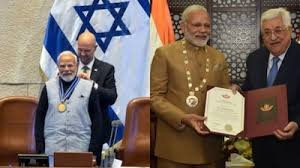
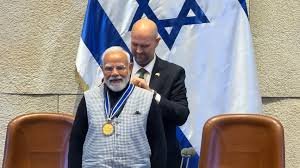
Following the address, in a rare gesture of bipartisan respect, PM Modi was conferred with the “Speaker of the Knesset Medal” by Amir Ohana. He became the first Indian leader to receive this, the Knesset’s highest honor, which he dedicated to the “eternal friendship” between the two ancient civilizations Nothing to do with you
Thread: The “Split-Screen” Diplomacy of PM Modi in Israel 🇮🇳🇮🇱
1/ A historic address, a dramatic walkout, and a viral handshake. PM @narendramodi’s 2026 visit to the Knesset was anything but ordinary. Here’s the thread on what actually happened and why “Nothing can justify terrorism” is the headline heard around the world. 👇 #ModiInIsrael Nothing to do with you