
The Decapitation Strategy: A Leadership in Crisis
Iran-Israel War 2026: The most significant “turn” in the war has been the unprecedented success of U.S. and Israeli intelligence in targeting the highest levels of the Iranian state. Iran-Israel War 2026
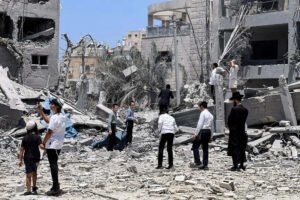
The Fall of the Old Guard: The initial wave of Operation Epic Fury on February 28 successfully assassinated Supreme Leader Ali Khamenei. Since then, the “decapitation” has continued. On March 17, 2026, Israel confirmed the deaths of Ali Larijani (Security Chief) and Gholamreza Soleimani (Head of the Basij paramilitary), dealing a devastating blow to Iran’s internal security and strategic planning. Iran-Israel War 2026
The Rise of Mojtaba Khamenei: Despite U.S. President Donald Trump publicly declaring Khamenei’s son “unacceptable” as a successor, the Assembly of Experts officially appointed Mojtaba Khamenei as the new Supreme Leader. This has signaled that the regime is not collapsing from within as hoped, but rather entrenching itself in a hardline “bunker mentality. Iran-Israel War 2026.
Financial Express: US, Israel War on Iran LIVE
The Hindu LIVE: Iran-Israel-USA War Updates
Military Stalemate and “Horizontal Escalation”
While the U.S. and Israel dominate the skies, Iran has adopted a strategy of horizontal escalation—widening the theater of war to make it too costly for the West to continue.
The Strait of Hormuz Blockade
Iran has effectively closed the Strait of Hormuz, through which 20% of the world’s oil passes. This has triggered a global energy crisis. President Trump has called on NATO and Asian allies to provide warships for a “freedom of navigation” mission, but many—including the EU—have so far refused, fearing a direct “shooting war” with Iranian coastal batteries. Iran-Israel War 2026
Regional Retaliation
Tehran’s retaliation has not been limited to Israel. Iranian missiles and “swarm drones” have struck:
-
U.S. Bases: Installations in Qatar, Bahrain, Kuwait, and the UAE have faced daily barrages.
-
Energy Infrastructure: Major oil depots and the Shah gas field in Abu Dhabi have been targeted, signaling that no energy asset in the Gulf is safe. Iran-Israel War 2026
-
The Baghdad Embassy: On March 17, the U.S. Embassy in Baghdad’s Green Zone was struck by drone fire, raising fears of a “Saigon-style” evacuation if the security situation in Iraq worsens. Iran-Israel War 2026
Latest Signals: Is De-escalation Possible?
The signals for peace are currently extremely weak. Both sides appear to be doubling down on their respective objectives.
Gold: The “Unusual” Safe Haven Behavior
| Metric | Current Status (March 17-18, 2026) |
| Price (24K) | ₹1.58–₹1.62 Lakh per 10 grams |
| Trend | Bearish/Volatile |
| Global Price | Above $5,000 per ounce |
The Energy Crisis: Fuel and LPG
The closure of the Strait of Hormuz (which handles 20% of global oil and 55% of India’s LPG imports) has created an immediate supply-side shock.
-
LPG & Cooking Gas: India is the world’s second-largest LPG importer, sourcing 91% of its supply from the Gulf. Domestic LPG prices were hiked by ₹60 per cylinder in the first week of March. To prevent hoarding, the government has increased the minimum waiting period for refills from 21 to 25 days. Iran-Israel War 2026
-
Fuel Prices: While global Brent crude has surged above $100–$120 per barrel, the Indian government has used price controls to limit the domestic diesel price hike to approximately 5% as of March 13. However, this is placing massive financial strain on Oil Marketing Companies (OMCs), whose profit margins are being “compressed” to shield consumers.
-
Essential Commodities Act: On March 10, the government invoked this act to prioritize gas for households, transport (CNG), and fertilizers, while capping industrial and manufacturing consumption at 80%. Iran-Israel War 2026
-
The Russian Pivot: Re-routing the Supply Chain
In a major strategic shift, India has surged its purchase of Russian crude to compensate for the Middle Eastern shortfall.
-
50% Surge in Imports: India’s Russian oil imports jumped to 1.5 million barrels per day (bpd) in March, up from 1.04 million in February. Iran-Israel War 2026
-
The 30-Day US Waiver: In a rare diplomatic move on March 6, the US Treasury issued a 30-day waiver allowing Indian refiners to purchase Russian oil currently “stranded at sea.” This has allowed roughly 15 million barrels of idling Russian crude to be diverted to Indian ports in the Arabian Sea and Bay of Bengal.
-
Logistics Pain: Despite the Russian pivot, the overall cost structure has worsened due to higher freight charges and skyrocketing marine insurance premiums as ships avoid the conflict zone.
Stock Market & Currency Volatility
Dalal Street has faced one of its most volatile months in recent history.
Signal A: Iran Rejects Ceasefire
Reports from March 17 indicate that Mojtaba Khamenei has rejected de-escalation offers conveyed by intermediaries (likely Oman and Egypt). His stance is that there will be no peace until the “U.S. and Israel are brought to their knees” and pay compensation for the assassinations. Iran-Israel War 2026
Signal B: U.S. Political Contradictions
The Trump administration has sent mixed signals regarding its ultimate goal:
-
Regime Change: Trump initially urged Iranians to “take over your government.”
-
The “Maduro Model”: More recently, he suggested he would be open to the regime staying in power if it “cooperates” with U.S. demands—a strategy similar to the capture of Nicolás Maduro in Venezuela.
-
Internal Resignation: The resignation of Joe Kent, a top counterterrorism official, over the war suggests growing friction within the U.S. government regarding the necessity and legality of the conflict.
Signal C: The “Donroe Doctrine”
Analysts have coined the term “Donroe Doctrine” (a play on the Monroe Doctrine) to describe Trump’s 2026 foreign policy: a focus on Western Hemispheric dominance while demanding that Eurasian allies pay for or handle their own regional security. This has created a “security void” that Iran and its proxies are exploiting. Iran-Israel War 2026
Economic and Humanitarian Impact
The war is no longer just a military event; it is a global economic shock.Iran-Israel War 2026
-
Oil Prices: Crude prices have spiked to record highs, leading to fuel rationing in parts of Asia and Europe.
-
Casualties: Estimates suggest over 2,000 dead across Iran, Israel, and Lebanon. Humanitarian groups like Amnesty International have raised alarms over civilian deaths, including a strike on a girls’ school in Minab that killed 170 people.
-
The Lebanon Front: Hezbollah has launched its highest volume of attacks in years, effectively turning the conflict into a two-front war for Israel. Iran-Israel War 2026
Summary Table: Conflict Status at a Glance
| Factor | Status | Impact |
| Iranian Leadership | Decapitated | High instability; Mojtaba Khamenei takes a hardline stance. |
| Global Energy | Critical | Strait of Hormuz closed; oil prices soaring. |
| U.S. Strategy | “Epic Fury” | Massive strikes on infrastructure; domestic political division. |
| Israel Status | High Alert | Dual-front war with Iran and Hezbollah; targeting top IRGC officials. |
| Diplomacy | Stalled | Iran demands “defeat and compensation” before talking. |
Summary of Macro Impact
-
GDP Forecast: Analysts suggest that if oil stays at $100, India’s GDP growth could fall from 7% to below 6.5%.
-
Inflation: Consumer inflation is expected to rise above 4.5% for the fiscal year due to the “knock-on” effects of energy costs.