
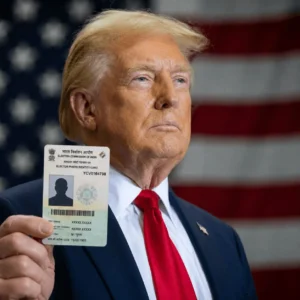
US President Donald Trump has once again brought election security into the political spotlight, this time by pointing to India’s election system as an example. Trump has argued that the United States should adopt tougher voter identification rules and has renewed his push for legislation aimed at requiring stronger proof of identity and citizenship in federal elections.
His remarks have added fresh energy to a long-running debate in American politics. Supporters of stricter voter ID requirements say such rules can improve confidence in elections and make the voting process more secure. Critics, however, argue that additional documentation requirements could make voting more difficult for some eligible American citizens.
Trump Points To India’s Voter ID System
Trump referred to India while making the case for tighter election rules in the United States. According to his remarks, India’s Chief Election Commissioner Gyanesh Kumar had raised a question with the Trump administration about how elections in America could be conducted without requiring every voter to show a valid photo ID.
Trump used this comparison to argue that if a democracy as large as India can operate elections with identification requirements, the United States should also be able to introduce stronger voter verification measures.
The comparison quickly attracted attention because India and the US are two of the world’s largest democracies, but their election systems work in significantly different ways. Donald Trump.
Election Commission of India — Official Website
Trump Highlights India’s Massive Number Of Voters
One of Trump’s main arguments focused on the scale of Indian elections.
He said that around 646 million voters participated in India’s most recent general election and claimed that less than 1% voted by mail. He also highlighted India’s use of photo identification at polling stations.
For Trump, these figures support his argument that large-scale elections can be conducted while maintaining strict identity-verification procedures. Donald Trump
However, simply comparing the two countries does not tell the whole story. India and the United States have different constitutional structures, voter-registration processes and election laws.
What Is The SAVE America Act?
Trump’s comments came as he renewed his push for the SAVE America Act, legislation aimed at strengthening voter eligibility and identification requirements in US federal elections. Donald Trump
Among the measures associated with the proposal are requirements involving proof of US citizenship and voter identification. The legislation has become an important part of Trump’s broader election-policy agenda.
Trump and his supporters argue that American elections should make it straightforward to verify that people participating in federal elections are legally eligible to vote.
Why Trump Wants Stronger Voter ID Rules
The basic argument from Trump and other supporters of stricter voter ID laws is simple: voters should be able to prove who they are before casting a ballot.
Supporters believe stronger identification requirements could increase public confidence in elections and provide another safeguard against improper voting. Donald Trump
Trump has repeatedly made election integrity a major political issue. His latest reference to India gives him an international example to support that argument. Donald Trump
At the same time, voter ID rules remain politically controversial in the United States.
USA.gov — Voting and Elections
Why Voter ID Is Such A Big Debate In America
Unlike India, the United States does not operate under one identical nationwide voter identification system for every election.
Election administration is highly decentralized, with individual states playing a major role in determining voting procedures. As a result, voter ID requirements can vary significantly depending on where an American voter lives.
Some states have strict photo identification requirements, while others provide different methods for verifying a voter’s identity.
Republicans Support Stronger Election Verification
Many Republicans have long supported tougher voter ID laws.
Their argument is that asking voters to provide identification is a reasonable election-security measure. They also say clearer identification rules could strengthen public trust in election results.
For Trump, the issue goes beyond simply showing an ID. His current push also focuses on verifying citizenship when people register to vote in federal elections. Donald Trump
Critics Raise Concerns About Voting Access
Democrats and voting-rights advocates have frequently challenged stricter voter ID proposals.
Their concern is that additional documentation requirements could create unnecessary barriers for eligible voters, particularly people who may have difficulty obtaining or producing required documents.
Critics also point out that non-US citizens are already prohibited from voting in federal elections, raising questions about whether additional federal requirements are necessary.
This creates the central political disagreement: supporters emphasize election security and verification, while opponents emphasize access and the risk of disenfranchising eligible citizens. Donald Trump
How Does India Verify Voters?
India operates elections on an enormous scale. The Election Commission of India manages elections involving hundreds of millions of eligible voters spread across cities, towns, villages and remote regions.
Voters are issued an Elector Photo Identity Card (EPIC), commonly known as a voter ID card. Election authorities also provide procedures involving approved alternative identification documents in certain circumstances.
This means the Indian system is more nuanced than saying that only one particular voter card can be used.
India Relies Heavily On In-Person Voting
Another major difference highlighted by Trump is postal voting. Donald Trump
India’s general elections rely overwhelmingly on voters physically visiting polling stations. Postal-ballot facilities exist for specific categories of eligible voters, but they are not used on the same scale as mail voting in parts of the United States.
Trump cited the relatively low use of postal ballots in India as another reason he believes the US should reconsider its approach.
Can America Simply Copy India’s Election Model?
Not exactly.
India and the United States have different political systems, election laws and administrative structures.
India’s elections are administered under a centralized national constitutional framework through the Election Commission of India, while American elections involve federal, state and local authorities.
That makes a direct copy-and-paste approach unrealistic.
The Two Democracies Have Different Election Structures
The United States gives individual states substantial authority over election administration.
This means changing voting requirements nationwide can involve complicated questions of federal law, state authority, constitutional rights and court challenges.
India’s system has developed under a different constitutional and administrative framework.
Therefore, India can be used as a political comparison, but implementing the same model in America would require dealing with major legal and practical differences. Donald Trump
India Responds To Trump’s Praise
Trump’s remarks also drew a response from India.
India’s Ministry of External Affairs said the credibility and robustness of India’s election machinery are well established globally, while avoiding an extended political response to Trump’s specific comments.
The response highlighted India’s confidence in its electoral institutions without directly entering the domestic American debate over voter ID laws. Donald Trump
India’s Election System Gets International Attention
Conducting elections for hundreds of millions of voters is an enormous logistical exercise.
Polling officials and security personnel must reach locations ranging from major metropolitan areas to remote communities. Electronic Voting Machines are widely used, and polling takes place in phases during national elections.
Because of this scale, India’s election system frequently receives international attention.
Trump’s latest comments have now brought one particular part of that system—voter identification—into the center of an American political debate. Donald Trump
Trump’s Comments Could Intensify US Election Debate
The timing of Trump’s remarks is politically significant because election rules remain a major issue in the United States.
Questions surrounding voter registration, citizenship verification, mail ballots and identification requirements have become highly partisan.
By citing India, Trump is trying to strengthen his argument that strict voter verification is compatible with running elections in a very large democracy.
But opponents are likely to continue asking whether proposed changes would actually improve election security enough to justify the additional burden placed on voters.
Election Security Versus Voting Access
Ultimately, the debate comes down to two priorities. Donald Trump
One side believes stronger voter identification and citizenship verification will protect election integrity and increase confidence in results.
The other side argues that election security measures should not make it unnecessarily difficult for legitimate voters to participate.
Both security and accessibility matter in a democratic system, which is why voter ID remains such a complicated political issue in America.
What Happens Next?
Trump is continuing to press lawmakers to support the SAVE America Act and other changes to US election rules.
Whether those proposals become law will depend on congressional support, political negotiations and potentially legal challenges.
The debate is unlikely to disappear quickly, especially as election policy continues to play a central role in American politics.
India-US Election Comparison May Continue
Trump’s reference to India shows how election practices in one democracy can become part of a political argument in another.
India’s huge electorate, widespread in-person voting and voter identification procedures give Trump a useful example for his case.
But the differences between the two countries are equally important. A policy that works within India’s election framework cannot necessarily be transferred directly to the United States. Donald Trump
Conclusion
Donald Trump’s decision to cite India’s election system has given a new international dimension to America’s voter ID debate.
Trump argues that India demonstrates how hundreds of millions of people can participate in elections while identity verification remains an important part of the voting process. He is using that comparison to push for the SAVE America Act and stricter voter identification and citizenship-verification rules.
Supporters see these measures as common-sense safeguards that could strengthen confidence in American elections. Critics fear that tougher documentation rules could make voting harder for some eligible citizens and argue that existing laws already prohibit non-citizens from voting in federal elections.
What is clear is that the debate is about much more than voter ID cards. It involves a larger question facing every democracy: how to protect election integrity while ensuring that every eligible citizen has a fair and practical opportunity to vote.
As the political fight continues in Washington, India’s election system is likely to remain an interesting reference point—but the final shape of US election rules will ultimately be determined by America’s own laws, institutions and voters.